

You’ve probably seen it happen. A company gets excited about artificial intelligence, launches a few projects, maybe builds a chatbot or tries some data model, and then… things stall. Results feel scattered. Teams lose momentum. Leadership starts questioning the investment.
So what went wrong?
It usually comes down to one simple issue. Companies jump into AI projects without having a clear strategy. They focus on doing instead of thinking through why they are doing it.
That gap creates confusion, wasted effort, and missed opportunities.
Let’s break this down in a way that actually makes sense.
What Is an AI Strategy, Really?
An AI strategy is not about picking tools or building models. It’s about deciding how artificial intelligence fits into your business goals.
It answers questions like:
- What problems are you trying to solve?
- Where can automation or prediction add value?
- How will success be measured?
Without this clarity, even the best technical work won’t move the needle.
Think of it like planning a trip. You don’t just start driving. You decide where you want to go, how you’ll get there, and what matters along the way.
That’s what a strategy does. It gives direction.
And yet, many companies skip this step.
What Are AI Projects?
AI projects are the actual tasks. These are things like:
- Building a recommendation engine
- Creating a chatbot
- Automating data processing
- Predicting customer behavior
They are specific. They have timelines. They involve teams and tools.
Projects are important. But they are not the starting point.
They are the result of a good strategy, not a replacement for it.
Where Things Start to Go Sideways
Here’s the pattern that shows up again and again.
A company hears about AI success stories. Competitors are doing it. Leadership feels the pressure. So they greenlight a few projects.
No clear roadmap. No defined outcomes. Just a push to “do something with AI.”
At first, it feels productive. Teams are busy. There’s progress.
But soon:
- Projects don’t connect with business goals
- Results are hard to measure
- Stakeholders lose confidence
- Budgets get questioned
Sound familiar?
This is what happens when projects come before strategy.
The Biggest Mistake: Treating AI Like a Feature
A lot of businesses treat AI as if it’s just another feature to add.
“Let’s add a chatbot.”
“Let’s automate this process.”
But AI is not just a feature. It changes how decisions are made, how data is used, and how systems interact.
When you treat it like a small add-on, you miss the bigger picture.
You end up with isolated tools instead of real impact.
Why Strategy Matters More Than Ever
Here’s the truth. AI is not cheap, and it’s not simple.
Without a strategy, you risk:
- Investing in the wrong areas
- Building solutions no one uses
- Creating systems that don’t scale
A good strategy helps you prioritize. It forces you to focus on what actually matters.
It also keeps everyone aligned. Leadership, product teams, developers, and stakeholders all work toward the same goals.
That alignment is what turns effort into results.
Common Pitfalls Companies Fall Into
Let’s talk about the specific ways companies go wrong.
1. Chasing Trends Instead of Solving Problems
It’s easy to get caught up in hype. New tools, new models, new possibilities.
But if you’re not solving a real business problem, none of it matters.
Ask yourself:
What pain point are we addressing?
If the answer isn’t clear, the project probably won’t deliver value.
2. Ignoring Data Readiness
AI depends on data. Not just any data, but clean, structured, and relevant data.
Many companies start projects without checking if their data is ready.
The result?
Delays. Poor performance. Frustration.
A strategy would highlight this early.
3. Lack of Clear Ownership
Who is responsible for AI in your company?
If the answer is “everyone,” that’s a problem.
Without clear ownership, decisions get delayed. Priorities shift. Projects lose direction.
A strategy defines roles and responsibilities upfront.
4. Measuring the Wrong Things
Some teams focus on technical metrics. Accuracy, model performance, processing speed.
Those are important, but they are not the end goal.
What matters is business impact.
Are you saving time? Increasing revenue? Improving customer experience?
If you can’t answer that, the project isn’t doing its job.
5. Trying to Do Too Much at Once
AI can do a lot. That’s part of the appeal.
But trying to tackle everything at once usually leads to failure.
A focused approach works better. Start small. Learn. Then expand.
How to Build a Strong AI Strategy
Now let’s get practical. What does a solid approach look like?
Start With Business Goals
Before anything else, define what success looks like.
Do you want to reduce costs? Improve efficiency? Enhance user experience?
Be specific.
This becomes your foundation.
Identify High-Impact Use Cases
Not all problems are worth solving with AI.
Look for areas where:
- Data is available
- Decisions are repetitive
- Outcomes can be measured
These are your best starting points.
Align Teams Early
Bring everyone into the conversation.
Product teams. Developers. Business leaders.
When people are aligned from the beginning, execution becomes smoother.
Plan for Data
Take a hard look at your data.
Is it clean? Accessible? Organized?
If not, fix that first.
Skipping this step will cost you later.
Choose the Right Partners
Sometimes you need external expertise. That’s fine.
Working with teams that offer AI Development Services can help you move faster and avoid common mistakes.
The key is to choose partners who understand your business, not just the technology.
Build, Measure, Learn
Start with a focused project. Track results. Learn from it.
Then expand.
This cycle keeps your efforts grounded and effective.
The Role of Skilled Talent
Even with a strong strategy, execution matters.
You need people who know how to build and manage AI solutions.
That’s where it makes sense to hire AI Developers who bring both technical skills and practical experience.
They can help bridge the gap between ideas and real-world results.
Without the right talent, even the best plans can fall apart.
Strategy First, Projects Second
Let’s simplify this.
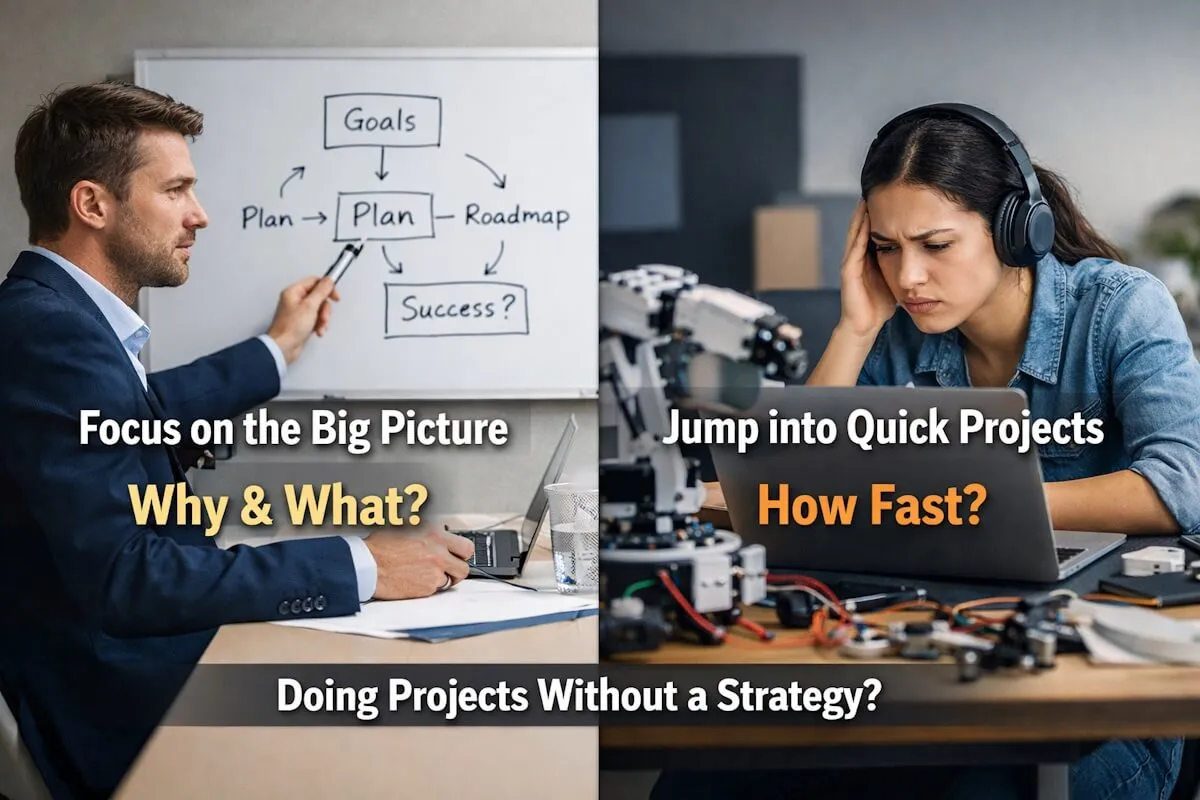
Strategy answers “why” and “what.”
Projects answer “how.”
If you skip the first part, the second part won’t work.
It’s that simple.
Yet many companies still get it backward.
They jump into building without thinking through the bigger picture.
And then they wonder why things don’t work out.
A Smarter Way Forward
If you’re considering AI or already working on it, take a moment and ask yourself:
- Do we have a clear strategy?
- Are our projects tied to business goals?
- Are we measuring real impact?
If the answer to any of these is no, it’s worth stepping back.
Not stopping. Just realigning.
Because when strategy and execution work together, things change.
Projects start delivering value. Teams gain confidence. Results become visible.
And suddenly, AI is no longer just an experiment. It becomes a real part of how your business operates.
One Last Thing Before You Go
You don’t need to do everything at once.
You don’t need perfect systems.
You just need clarity.
Start there.
Because the difference between success and failure with AI often comes down to one choice.
Do you lead with strategy, or do you jump straight into projects?
Pick wisely.