

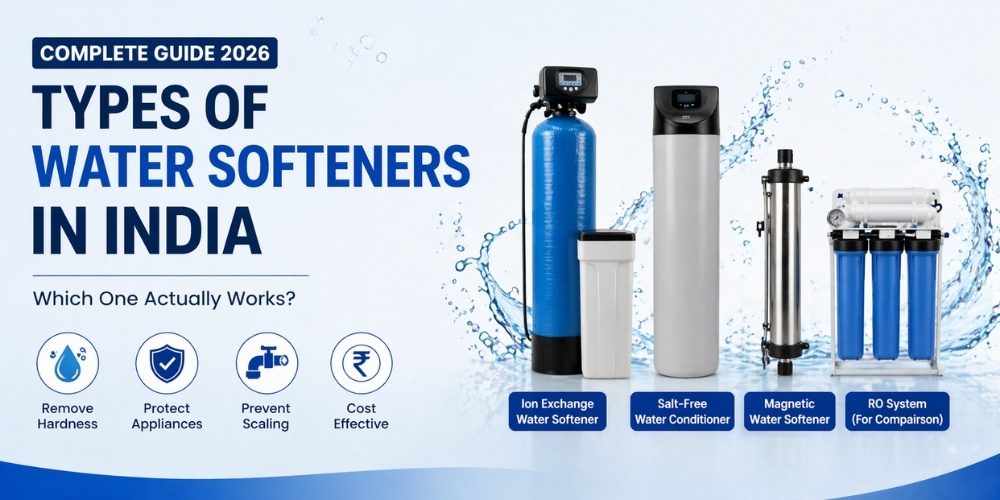
Choosing a water conditioner is not necessarily a decision that can be made by comparing prices alone. UK homes have different plumbing layouts, water usage patterns and levels of water hardness, while conditioning systems can use different technologies and have different installation requirements.
For homeowners dealing with persistent limescale, comparing these factors before buying can help avoid choosing equipment that does not suit the property. The aim is not simply to find a particular brand, but to understand how each option fits the household.
From installation and maintenance to long-term costs and the type of limescale problem being experienced, there are several points worth considering before making a decision.
Start With the Hard-Water Problem
Before comparing products, identify what hard water is actually doing in the home.
Limescale is most visible where water is heated or allowed to evaporate. Bathroom taps, showerheads, shower screens and basins can develop chalky deposits, while kettles are another familiar example.
In some properties, the issue may be largely cosmetic. Regular cleaning and descaling may be enough to keep deposits manageable. In others, limescale can be a recurring maintenance concern across bathrooms, appliances and hot-water equipment.
The local water supply should also be considered. Hardness varies across the UK, so homeowners should check information from their local water company rather than relying solely on assumptions about their area.
Once the problem has been identified, it becomes easier to determine whether a water conditioner is worth considering and what type of system may be appropriate.
What Makes One Conditioner Different From Another?
Water conditioners are not all based on the same technology.
Some systems are designed to influence how minerals behave and form scale, while traditional water softeners use an ion-exchange process to reduce the concentration of calcium and magnesium in treated water.
This difference is important because conditioning should not automatically be understood as the same thing as softening. A homeowner comparing systems needs to understand the intended function of each product rather than treating the two terms as interchangeable.
The way a system is installed can differ too. Some conditioners are designed for installation inline with the incoming mains supply, allowing the treatment to be applied across the property’s water system.
Homeowners researching the market may come across products such as BathroomDuck Halcyan Solution. Halcyan’s H2o9 is described by the supplier as a whole-house, inline water conditioner designed to address limescale without salt or chemical additives. Its product information also states that the system requires no ongoing maintenance.
These details can make it an interesting option to investigate, but homeowners should still assess the product against their own property’s requirements.
Consider the Installation
A water conditioner can only be useful if it is installed in an appropriate location and is suitable for the existing plumbing.
The incoming mains pipework is an important consideration for whole-property systems. Homeowners should identify where the mains supply enters the building and determine whether there is enough space to install the chosen equipment.
Older properties can present additional challenges. Pipework may have been altered over the years, and access to the incoming supply may be restricted by cupboards, flooring or other fixtures.
Professional installation can help establish whether the selected system is appropriate and whether any changes to the pipework will be required.
It is also worth checking whether the equipment is available for the pipe size used in the property. Product ranges can differ, so homeowners should not assume that one model will suit every installation.
Household Size and Water Usage
The needs of a household can influence which system makes sense.
A small property occupied by one or two people may have relatively modest water usage, while a larger family home could have several bathrooms and multiple appliances using water at the same time.
This matters when assessing treatment equipment because systems can have specific operating requirements. Homeowners should look at the manufacturer’s guidance rather than selecting a product simply because it is marketed as suitable for domestic use.
Consider the property’s current needs as well as possible future changes. A growing family, additional bathroom or home extension could alter water usage and potentially affect the suitability of an existing system.
Getting the sizing right is therefore an important part of the comparison process.
Maintenance and Everyday Convenience
Maintenance is another area where products can differ considerably.
Some homeowners prefer equipment that requires regular attention because they are comfortable managing consumables or servicing. Others may prioritise a system designed to operate without salt top-ups, regeneration cycles or routine servicing.
Neither preference is automatically right or wrong. It depends on how much involvement the homeowner is prepared to accept after installation.
Halcyan’s product information describes its H2o9 conditioner as a zero-maintenance system and states that it operates without salt or chemicals. These are specific product characteristics that homeowners can take into account when comparing it with other approaches.
The key is to look beyond the phrase “maintenance-free” or similar descriptions and establish exactly what the manufacturer recommends. Even systems marketed as requiring little maintenance should be installed and used according to the manufacturer’s instructions.
Comparing the Overall Cost
Purchase price is an obvious factor, but it should not be the only financial consideration.
A more useful comparison looks at the total cost of owning the system. This can include installation, servicing, replacement components, consumables and any other ongoing expenses.
For example, a system requiring regular salt purchases will have a different running-cost structure from one designed without salt. Likewise, a system requiring professional servicing may have different long-term costs from one designed for minimal intervention.
Homeowners should also consider the value of convenience. Spending less initially may not necessarily provide the simplest option if the system requires more ongoing attention.
Obtaining an installation quotation before purchasing can help establish the actual upfront cost rather than relying solely on the advertised price of the equipment.
Exploring Another Conditioning Option
Another product homeowners may encounter while comparing systems is the Inta ActivFlo Water Conditioner.
According to the product information, ActivFlo is designed as an inline whole-property limescale protection system. It is fitted to the incoming mains supply and uses a catalytic alloy coil as part of its conditioning process.
The manufacturer’s information also describes the system as requiring no salt, chemicals or electricity and states that it is designed for zero ongoing maintenance. Different versions are available to accommodate different domestic pipework and flow requirements.
For a homeowner considering this type of system, these characteristics can be compared directly with the requirements of the property. Installation position, pipework, flow rate and household water usage should all be checked before selecting a particular model.
The important point is that comparison should remain factual. Halcyan, ActivFlo and other conditioning systems can have different designs and specifications, so homeowners should assess each product according to what it offers and what their home requires.
Questions Worth Asking Before Buying
A few practical questions can make the buying process much clearer:
- How hard is the local water supply?
- Where is limescale causing the greatest inconvenience?
- Is whole-property protection required?
- Where can the system be installed?
- What pipe size does the property use?
- Is professional installation necessary?
- Does the system require salt, chemicals or electricity?
- What maintenance is expected?
- Are there replacement parts or consumables?
- What is the full installation cost?
- Does the system suit the household’s water usage?
Answering these questions can help homeowners compare products on meaningful factors rather than simply choosing the one with the most appealing description.
Finding a Suitable Option
Water conditioners can provide homeowners with an alternative approach to managing the practical effects of hard water, but there is no reason to assume that every system will suit every property.
A sensible comparison starts with the household rather than the product. Understand the local water hardness, identify where limescale is occurring and consider how much maintenance the household is willing to undertake.
From there, compare installation requirements, technology, sizing, maintenance and total cost. Looking at these factors together can make the decision considerably more straightforward.
Whether a homeowner chooses to continue with regular descaling, investigates a conventional softener or compares different water conditioners, the most useful purchase is one that fits the property’s actual needs. Careful research before installation can help ensure that the chosen approach is practical for everyday household use.